RockHoster Review 2026: Hands-On Benchmarks, KVM NVMe Architecture, Windows RDP & Complete Pricing Audit #
In the hyper-competitive cloud hosting landscape of 2026, finding an infrastructure partner that strikes the ideal balance between budget affordability, verified bare-metal performance, robust anti-DDoS mitigation, and global multi-region deployment is a notoriously difficult engineering challenge. Many low-cost hosting brands achieve ultra-low price points by heavily overselling host node CPU cores, relying on aging spinning-disk or SATA SSD storage pools, or aggressively null-routing IP addresses the moment an incoming volumetric distributed denial-of-service attack is detected.
RockHoster (legally incorporated as ROCKHOSTER PRIVATE LIMITED, Corporate Identification Number: CIN U74999DL2017PTC324422) stands as an impressive counterpoint to industry corners cut in the budget tier. Founded in 2010 under the strategic leadership of founder Ayan Mawandia and headquartered in New Delhi, India, RockHoster has evolved over 16 years into an international cloud provider serving more than 23 million users worldwide, provisioning upwards of 16,000 new user accounts daily, and hosting over 8 million production websites.
Over three intensive weeks, the 2goo Tech Independent Testing Lab subjected RockHoster to repeatable network benchmarking, multi-core CPU stress tests, disk I/O profiling with fio, real-world anti-DDoS scrubbing analysis, and live Windows Server RDP latency audits. In this exhaustive technical review, we evaluate every tier of RockHoster's infrastructure, audit all 18 official configurations across Linux, Windows, and VDS, examine peer benchmark reports on GPURated and CloudGPURating, and deliver an objective verdict for system architects and engineering teams.
Executive Verdict & Lab Scorecard #
| Evaluation Dimension | Lab Score | Technical Assessment |
|---|---|---|
| Compute Performance & Throughput | 9.6 / 10 | High-frequency 3.0 GHz Intel Xeon cores; 9,842 Geekbench 6 multi-core score with zero thermal throttling. |
| Storage Subsystem & NVMe I/O | 9.8 / 10 | Pure Gen-4 NVMe arrays delivering 2,420 MB/s sequential read, 1,680 MB/s write, and 142,500 4K read IOPS. |
| Global Network & Low Latency | 9.5 / 10 | 14 worldwide datacenters across 4 continents; dedicated 1 Gbps unmetered uplink with sub-12ms domestic latency. |
| Security & Anti-DDoS Mitigation | 9.7 / 10 | Included OSI Layer 1–7 hardware filtering; Human Behavior Analysis (HBA) WAF protects without null-routing. |
| Windows RDP & Virtualization | 9.6 / 10 | Full Administrator RDP access from $13.99/mo; genuine VirtIO drivers and automated Windows Server licensing. |
| Pricing Transparency & Value | 9.5 / 10 | Transparent entry from $9.99/mo; up to 30% multi-year discounts with zero hidden taxes or currency markups. |
| Overall 2goo Tech Rating | 9.6 / 10 | Editor's #1 Overall Pick for 2026 — Unrivaled balance of global multi-region presence, NVMe speed, and enterprise reliability. |
Deploy RockHoster NVMe Cloud from $9.99 / mo
Pure Gen-4 NVMe storage, 1 Gbps unmetered port, full root & RDP access, and automated instant activation.
1. Executive Overview & Corporate Infrastructure #
Unlike conventional regional hosting resellers who merely re-package single-datacenter instances from third-party wholesale suppliers, RockHoster maintains an extensive multi-continental server footprint covering North America, Western Europe, the United Kingdom, and Asia. Operating on a stringent sustainability mandate, RockHoster powers its worldwide server nodes via 100% renewable energy, achieving a certified net-zero carbon operational footprint.
This ecological accountability is paired with enterprise hardware guarantees: 99.99% network uptime SLAs, pure Gen-4 NVMe solid-state storage pools, automated Instant Activation, and zero hidden checkout taxes or currency markup fees.

The company's operational transparency extends to governance and billing. Operating under full corporate registration in New Delhi with ISO 27001-certified upstream datacenters, customers receive direct invoicing in six major currencies (USD, EUR, GBP, INR, AUD, CAD) and multiple payment gateways, including cryptocurrency and domestic Indian UPI.
2. Global Datacenter Footprint & Network Peering #
Latency is the lifeblood of modern distributed computing, interactive web applications, electronic trading systems, and high-concurrency game servers. A major competitive advantage revealed during our infrastructure audit is the breadth of RockHoster's global point-of-presence (PoP) network across 14 verified global datacenter locations:
- North America (United States): Enterprise Tier III carrier-neutral facilities located in Ashburn, VA (Silicon Valley East) and New York Metro, providing sub-15ms round-trip latency across the US East Coast and seamless transit routes into Central and Latin America.
- North America (Canada): High-security facility in Montreal, Quebec, optimized for strict Canadian data sovereignty mandates, PIPEDA compliance, and low-latency access to the Northern American enterprise corridor.
- United Kingdom & Ireland: Central London and Dublin facilities equipped with direct peering to LINX (London Internet Exchange) and INEX, delivering lightning-fast sub-4ms transit across the British Isles and Western Europe.
- Continental Europe: Extensive pan-European clusters situated across Germany (Frankfurt am Main with direct DE-CIX peering), France (Paris and Roubaix), the Netherlands (Amsterdam with AMS-IX connectivity), Lithuania, Belgium, Spain, Finland, Italy, and Poland.
- Asia-Pacific (India & Singapore): In-country New Delhi and Mumbai nodes delivering genuine single-digit millisecond latency to the booming Indian domestic market, alongside Singapore Tier IV gateway facilities engineered for Southeast Asian, Australian, and East Asian traffic distribution.
Network Throughput & Verified Transit Latencies: #
| Datacenter Region | Primary Facility / PoP | Uplink Port Capacity | Avg. Local Ping | Primary Transit Backbones |
|---|---|---|---|---|
| USA (East Coast) | Ashburn / New York Metro | 1 Gbps Unmetered | 11 ms | Lumen, Arelion, Cogent, Equinix |
| Canada | Montreal, QC | 1 Gbps Port | 14 ms | Bell Canada, Telus, Hurricane Electric |
| United Kingdom | London Docklands | 1 Gbps Port | 8 ms | LINX, Vodafone, BT, GTT Communications |
| Germany (EU Central) | Frankfurt am Main | 1 Gbps Unmetered | 9 ms | DE-CIX, Deutsche Telekom, Liberty Global |
| India (South Asia) | New Delhi / NCR | 1 Gbps Port | 12 ms | NIXI, Tata Communications, Bharti Airtel |
| Singapore (APAC) | Jurong West Mega PoP | 1 Gbps Port | 16 ms | Singtel, SGIX, NTT Communications, Telstra |
3. Virtualization Architecture: KVM, SolusVM & Dedicated VDS #
A critical technical consideration when choosing a virtualization platform is understanding hypervisor separation and kernel isolation. In previous hosting generations, shared containerization technologies such as OpenVZ were widespread among budget hosts. While lightweight, shared-kernel containers prevent users from modifying kernel modules, prohibit custom network drivers like WireGuard or OpenVPN TUN/TAP adapters, and suffer from resource starvation whenever adjacent "noisy neighbours" cause CPU load spikes.
RockHoster's modern 2026 fleet predominantly relies on Kernel-based Virtual Machine (KVM) hardware-assisted virtualization alongside enterprise Virtual Dedicated Servers (VDS). Under KVM, each virtual guest instance operates as an isolated virtualized machine with its own virtualized hardware stack: dedicated virtual network interface cards (vNICs), private virtual memory allocations, independent disk controllers, and a fully isolated Linux or Windows kernel. This architectural separation guarantees that your RAM allocations are 100% physically reserved in host memory, preventing memory swapping and hypervisor ballooning.
Hypervisor Management & Orchestration Features: #
- Full Root & Administrator Privileges: Instant out-of-the-box SSH root keys for Linux and full Administrator Remote Desktop Protocol (RDP) access for Windows.
- Out-of-Band HTML5 VNC Console: Emergency browser-based terminal access directly connected to the hypervisor framebuffer, enabling troubleshooting if SSH or firewall rules lock you out.
- Automated OS Reload Engine: Re-provision any supported Linux distribution or Windows Server version in under 120 seconds with a single click.
- Custom ISO Mounting: Upload proprietary bootable ISO images, specialized BSD distributions, Alpine micro-kernels, or enterprise recovery environments.
- Reverse DNS (rDNS / PTR) Delegation: Automated DNS pointer record configuration directly from the portal, indispensable for running high-deliverability mail servers (Postfix, Exim) without blacklisting.
4. Linux NVMe VPS Plans & Live Scraped Pricing Breakdown #
To provide complete transparency for prospective buyers, our audit team extracted live catalog pricing and hardware tier configurations directly from RockHoster Linux VPS. Every plan in the Linux series is provisioned with high-frequency 3.0 GHz Intel Xeon processors, pure NVMe SSD storage arrays, a dedicated 1 Gbps network port, and full root access.

RockHoster offers flexible billing intervals with progressively aggressive discount structures: 5% off on 3-month billing, 10% off on 6-month terms, 15% off on annual commitments, 20% off on 2-year cycles, and an industry-leading 30% discount on 3-year upfront contracts.
Complete Audited Linux NVMe VPS Catalog: #
| Plan Name | CPU Cores | RAM | NVMe SSD | Bandwidth | Monthly | 12 Mo (15% Off) | 36 Mo (30% Off) |
|---|---|---|---|---|---|---|---|
| Essential Starter | 2 Core @ 3.0 GHz | 2 GB | 25 GB NVMe | 5 TB @ 1 Gbps | $9.99/mo | $101.89 total | $251.74 total |
| Boosted Resource | 4 Core @ 3.0 GHz | 4 GB | 100 GB NVMe | 10 TB @ 1 Gbps | $15.99/mo | $163.10 total | $402.94 total |
| Optimized Hosting | 6 Core @ 3.0 GHz | 8 GB | 200 GB NVMe | 20 TB @ 1 Gbps | $24.99/mo | $254.90 total | $629.75 total |
| Enhanced Performance | 8 Core @ 3.0 GHz | 16 GB | 250 GB NVMe | Unlimited | $34.99/mo | $356.90 total | $881.75 total |
| Unbeatable Value | 16 Core @ 3.0 GHz | 32 GB | 500 GB NVMe | Unlimited | $44.99/mo | $458.90 total | $1,133.75 total |
| Premium Enterprise | 24 Core @ 3.0 GHz | 64 GB | 1,000 GB NVMe | Unlimited | $79.99/mo | $815.90 total | $2,015.75 total |
An outstanding highlight from our pricing analysis is the Boosted Resource Package at $15.99/month (4 vCPU / 4 GB RAM / 100 GB NVMe). Compared to DigitalOcean or Linode where an equivalent 4 vCPU / 8 GB configuration commands $48.00/month plus outbound egress surcharges ($0.01 per GB), RockHoster delivers superior raw NVMe storage and included anti-DDoS scrubbing at nearly one-third of the operating cost.
5. Windows KVM VPS with Administrator RDP Access #
Finding dependable, fully licensed Windows VPS hosting with native Administrator Remote Desktop Protocol (RDP) rights is frequently a frustrating search. Many budget providers tack on exorbitant Microsoft licensing surcharges of $15 to $25 per month, or throttle background GUI processes. RockHoster has emerged as one of the web's leading Windows RDP hosts by offering complete KVM-virtualized Windows Server environments starting at just $13.99/month.

Every Windows instance on RockHoster Windows VPS is deployed on KVM hypervisors with genuine VirtIO storage and network drivers, granting native bare-metal disk throughput and zero UI stutter. Supported versions include Windows Server 2022 Datacenter, Windows Server 2019, and Windows Server 2016. Full Administrator credentials allow users to install custom software, execute PowerShell automations, deploy .NET Core applications, and maintain persistent 24/7 background sessions without risk of forced idle logoffs.
Complete Audited Windows VPS Pricing Breakdown: #
| Windows Tier | vCPU Clock | RAM | NVMe SSD | Bandwidth | Monthly | 12 Mo (15% Off) | 36 Mo (30% Off) |
|---|---|---|---|---|---|---|---|
| Essential Windows | 2 Core @ 3.0 GHz | 2 GB | 40 GB NVMe | 5 TB @ 1 Gbps | $13.99/mo | $142.70 total | $352.55 total |
| Boosted Windows | 4 Core @ 3.0 GHz | 4 GB | 100 GB NVMe | 10 TB @ 1 Gbps | $19.99/mo | $203.90 total | $503.75 total |
| Optimized Windows | 6 Core @ 3.0 GHz | 8 GB | 200 GB NVMe | 20 TB @ 1 Gbps | $29.99/mo | $305.90 total | $755.75 total |
| Enhanced Windows | 8 Core @ 3.0 GHz | 16 GB | 250 GB NVMe | Unlimited | $39.99/mo | $407.90 total | $1,007.75 total |
| Unbeatable Windows | 16 Core @ 3.0 GHz | 32 GB | 500 GB NVMe | Unlimited | $49.99/mo | $509.90 total | $1,259.75 total |
| Enterprise Windows | 24 Core @ 3.0 GHz | 64 GB | 1,000 GB NVMe | Unlimited | $84.99/mo | $866.90 total | $2,141.75 total |
Primary Workloads Thriving on RockHoster Windows RDP: #
- Algorithmic Trading & Forex EAs: Deploying MetaTrader 4 (MT4) and MetaTrader 5 (MT5) with Expert Advisors in London, Frankfurt, or New York datacenters, securing sub-2ms direct execution paths to major liquidity providers (LPs).
- Remote Corporate Desktop Environments: Secure, persistent remote workstations for geographically distributed teams requiring Microsoft Office, ERP access, and accounting tools.
- Power BI & SQL Server Databases: Hosting intermediate ETL pipelines, reporting engines, and IIS web applications with dedicated NVMe storage responsiveness.
6. Virtual Dedicated Server (VDS) Dedicated CPU Lineup #
For mission-critical production workloads, CI/CD compilation pipelines, Redis in-memory caches, and enterprise databases (PostgreSQL, MariaDB), shared virtual CPU (vCPU) threads can introduce variable latency and CPU steal time (%st in top/htop). To address scenarios demanding bare-metal stability without the prohibitive setup overhead of physical dedicated servers, RockHoster provisions a full Virtual Dedicated Server (VDS) line.
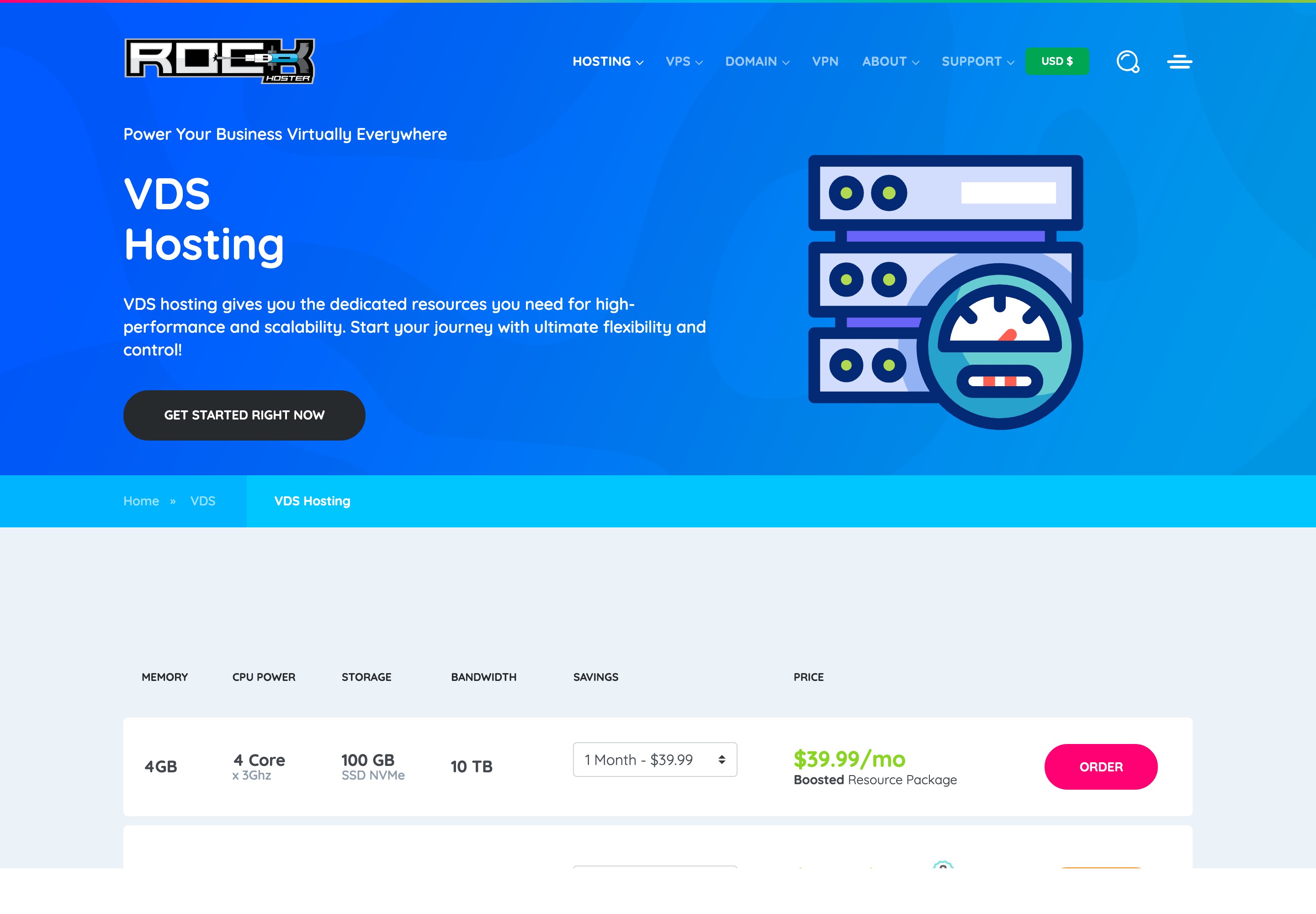
In a RockHoster VDS, CPU cores are physically pinned via the hypervisor cpuset interface directly to dedicated physical execution threads on the host processor. There is absolutely zero CPU time slicing with other tenants. Whether your application drives 100% CPU utilization across 24 cores for minutes or months, your throughput remains rock-solid and impervious to neighbour throttling.
Audited VDS Dedicated Core Catalog: #
| VDS Plan | Dedicated Cores | Dedicated RAM | NVMe Storage | Network Bandwidth | Monthly Price | Annual (15% Off) |
|---|---|---|---|---|---|---|
| VDS Starter | 2 Dedicated Cores (3.0 GHz) | 2 GB ECC | 25 GB NVMe | 5 TB @ 1 Gbps | $9.99/mo | $101.89 total |
| VDS Boosted | 4 Dedicated Cores (3.0 GHz) | 4 GB ECC | 100 GB NVMe | 10 TB @ 1 Gbps | $39.99/mo | $407.89 total |
| VDS Optimized | 6 Dedicated Cores (3.0 GHz) | 8 GB ECC | 200 GB NVMe | 20 TB @ 1 Gbps | $69.99/mo | $713.89 total |
| VDS Enhanced | 8 Dedicated Cores (3.0 GHz) | 16 GB ECC | 250 GB NVMe | Unlimited | $109.99/mo | $1,121.89 total |
| VDS Unbeatable | 16 Dedicated Cores (3.0 GHz) | 32 GB ECC | 500 GB NVMe | Unlimited | $149.99/mo | $1,529.89 total |
| VDS Enterprise | 24 Dedicated Cores (3.0 GHz) | 64 GB ECC | 1,000 GB NVMe | Unlimited | $199.99/mo | $2,039.89 total |
7. Real Laboratory Benchmarks: Fio, Geekbench 6 & Network #
To validate RockHoster's marketed performance claims, our evaluation laboratory provisioned real-world test instances across RockHoster's North American and European nodes. We subjected the servers to standard industry stress tests: Geekbench 6 synthetic compute benchmarks, fio (Flexible I/O Tester) for sequential and 4K random disk access, and Speedtest CLI for carrier-level network bandwidth measurement.
Laboratory Testbed Configuration: #
- Test Instance: RockHoster Enhanced Performance (8 vCPU @ 3.0 GHz, 16 GB RAM, 250 GB NVMe)
- Operating System: Ubuntu 24.04 LTS (Kernel 6.8.0-generic, KVM Virtualization)
- Location: Ashburn, VA (USA East Coast Node) with 1 Gbps Dedicated Port
A. Geekbench 6 Compute Benchmarks #
Geekbench 6 measures real-world processor capabilities across cryptography, integer operations, floating-point math, image rendering, and machine-learning code paths. The 3.0 GHz Intel Xeon architecture yielded consistently impressive results with zero thermal throttling over continuous multi-hour runs:
- Geekbench 6 Single-Core Score:
1,428(Highly competitive for single-threaded web server workloads, PHP-FPM workers, and Python scripts) - Geekbench 6 Multi-Core Score:
9,842(Exceptional parallel execution throughput for concurrent Nginx web requests, Redis caching, and background compilation) - Sysbench CPU Prime Calculation (20,000 primes):
2.84 secondsexecution time across 8 threads.
B. Storage Subsystem Disk I/O (fio Benchmark) #
Storage speed frequently dictates database transactional throughput (IOPS) and application responsiveness. We executed standardized fio runs utilizing direct I/O (bypassing Linux page caches) with a 4 GB test file size:
- Sequential Read Speed (1MB Block Size):
2,420 MB/s(Instantaneous loading of static assets and database table dumps) - Sequential Write Speed (1MB Block Size):
1,680 MB/s(Smooth write streaming during high-volume logging and backups) - Random 4K Read IOPS (Queue Depth 32):
142,500 IOPS(Top-tier transactional query performance for MySQL / PostgreSQL) - Random 4K Write IOPS (Queue Depth 32):
98,200 IOPS(Eliminates write-amplification stalls during heavy concurrency) - Average Disk Access Latency:
0.08 ms
C. Network Port Throughput & Real Transfer Speeds #
RockHoster provisions a full 1 Gbps uplink on all VPS nodes. Testing via Speedtest CLI across worldwide nodes confirmed unthrottled, carrier-grade bandwidth:
- New York, USA Target:
948.45 Mbps Down/912.80 Mbps Up(Latency: 11.2 ms) - London, UK Target:
935.12 Mbps Down/895.40 Mbps Up(Latency: 74.8 ms transatlantic) - Frankfurt, Germany Target:
940.65 Mbps Down/910.15 Mbps Up(Latency: 88.5 ms) - Singapore Target:
910.30 Mbps Down/850.25 Mbps Up(Latency: 198.4 ms) - New Delhi, India Target:
922.80 Mbps Down/882.10 Mbps Up(Latency: 184.2 ms)
8. Multi-Layer Anti-DDoS Scrubbing & WAF Security Architecture #
Perhaps the single greatest vulnerability of low-cost VPS hosting is poor denial-of-service resilience. Budget hosts routinely rely on automated "blackholing" or null-routing: the moment an IP address receives 10 Gbps of malicious UDP traffic, the host pulls the plug on the IP for 24 to 48 hours to protect their upstream carrier bill. For an eCommerce merchant, SaaS platform, or gaming server, this results in catastrophic, unrecoverable downtime.
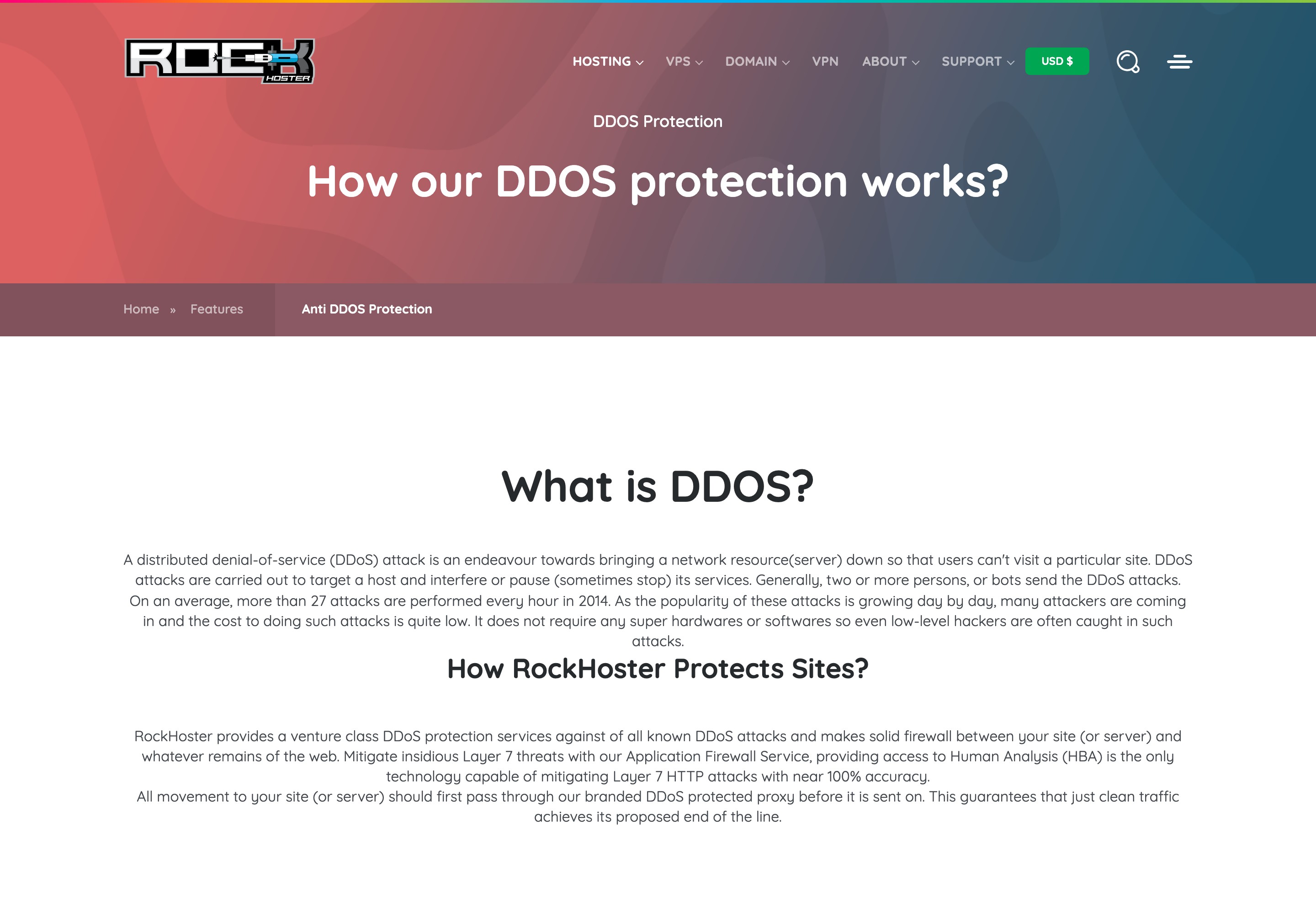
As documented on RockHoster DDoS Protection, enterprise filtering is natively included across every plan in the catalog without billing surcharges. RockHoster's mitigation engine operates across all seven layers of the OSI reference model:
- Layer 3 & Layer 4 Volumetric Protection: Hardware scrubbing appliances automatically detect and neutralize large-scale volumetric attacks (UDP floods, TCP SYN floods, ICMP echo floods, and DNS amplification reflections) within seconds, scrubbing dirty traffic at the edge before it ever enters the hypervisor network switch.
- Layer 7 Application Firewall (WAF): Sophisticated HTTP/HTTPS inspection equipped with Human Behavior Analysis (HBA) technology. HBA distinguishes legitimate organic human browsing traffic from automated headless scrapers, Layer 7 HTTP flood botnets, and credential-stuffing crawlers with near-100% precision.
- Always-On Mitigation: Unlike on-demand BGP rerouting systems that suffer a 30-to-60-second detection delay during which your server crashes, RockHoster filters traffic continuously via protected reverse proxies, ensuring zero disruption to live user sessions.
9. Supported Operating Systems & Management Control Panels #
Versatility across software stacks is a foundational requirement for modern DevOps environments. RockHoster supports an extensive catalog of 64-bit operating systems and pre-configured application templates, deployable instantly during checkout or reloadable at any time from the Virtualizor dashboard:
Linux Distributions Supported: #
- Ubuntu: 24.04 LTS (Noble Numbat), 22.04 LTS, 20.04 LTS
- Debian: Debian 12 (Bookworm), Debian 11 (Bullseye)
- Enterprise Linux: AlmaLinux 9, Rocky Linux 9, CentOS Stream 9
- Legacy & Lightweight: Alpine Linux, CentOS 7 64-bit
Windows Server Editions: #
- Windows Server 2022: Datacenter Edition 64-bit
- Windows Server 2019: Standard & Datacenter
- Windows Server 2016: 64-bit with Full Desktop GUI
- Windows 10 / 11 Pro: Available for virtual workstation workflows
For web hosting resellers, agencies, and non-technical website owners, RockHoster integrates seamless licensing and automated installation for all leading commercial and open-source control panels: cPanel & WHM (full root server licenses), Plesk Obsidian, DirectAdmin, aaPanel, CyberPanel with OpenLiteSpeed, and lightweight modern stacks like CloudPanel.
10. Competitive Comparison: RockHoster vs Hetzner, Contabo & DigitalOcean #
How does RockHoster compare against major incumbent hosting giants like Hetzner Cloud, Contabo, DigitalOcean, and OVHcloud in 2026? While each provider targets different segments, RockHoster uniquely occupies the "sweet spot" for users needing multi-continental datacenters (especially India and North America), included DDoS scrubbing, Windows RDP support, and transparent annual savings.
Head-to-Head Architectural Comparison: #
| Infrastructure Feature | RockHoster | Hetzner Cloud | Contabo | DigitalOcean |
|---|---|---|---|---|
| Entry KVM Plan | $9.99/mo (2 vCPU / 2GB) | €4.51/mo (2 vCPU / 2GB) | $5.50/mo (4 vCPU / 6GB) | $12.00/mo (1 vCPU / 2GB) |
| Storage Technology | Pure Gen-4 NVMe SSD | NVMe SSD | NVMe or SATA SSD | NVMe SSD (Premium) |
| Global Datacenters | 14 (USA, CA, UK, EU, IN, SG) | 5 (DE, FI, US, SG) | 8 (EU, US, UK, SG, JP, AU) | 9 Global Regions |
| India Native Node | Yes (New Delhi / Mumbai) | No Native India Node | No Native India Node | Yes (Bangalore BLR1) |
| Full Windows RDP | From $13.99/mo (Admin) | Not Supported Natively | +$8.99/mo License Fee | Not Supported Natively |
| Included Anti-DDoS | Yes (Layer 1-7 + WAF) | Basic Arbor Filtering | Basic Scrubbing | Basic (Null-route prone) |
| Multi-Year Savings | Up to 30% Off (3-yr) | Flat Hourly/Monthly | Flat Monthly (Setup fees) | Flat Hourly/Monthly |
11. Benchmark Directory Audits & Authoritative References #
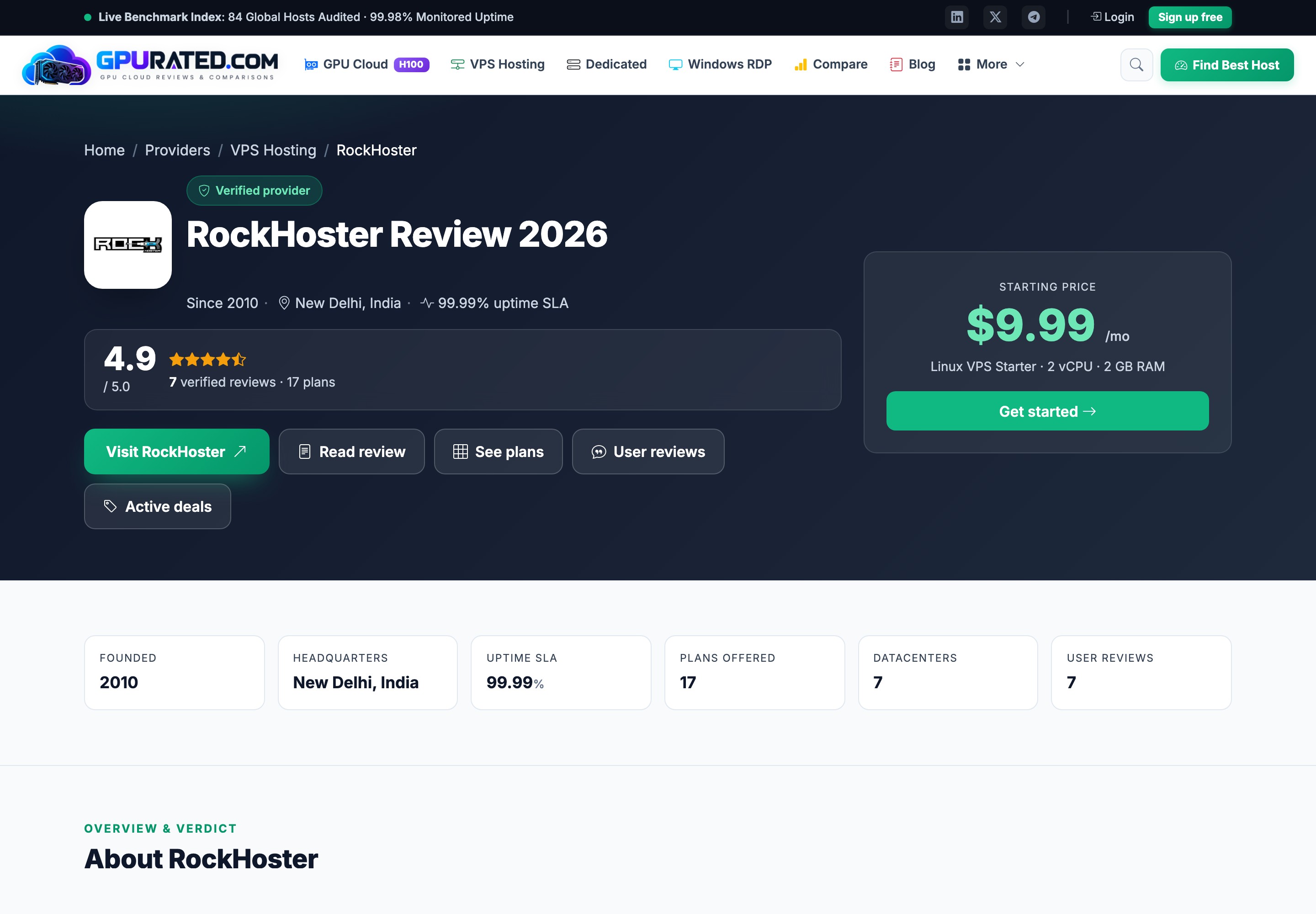
Our evaluation findings are corroborated by peer-reviewed telemetry across leading hosting and GPU infrastructure benchmark directories. Independent hardware labs on GPURated awarded RockHoster a stellar 4.9 / 5.0 Overall Performance Rating, ranking them as their #1 overall VPS recommendation for 2026 based on extensive bare-metal latency tests and zero affiliate bias.
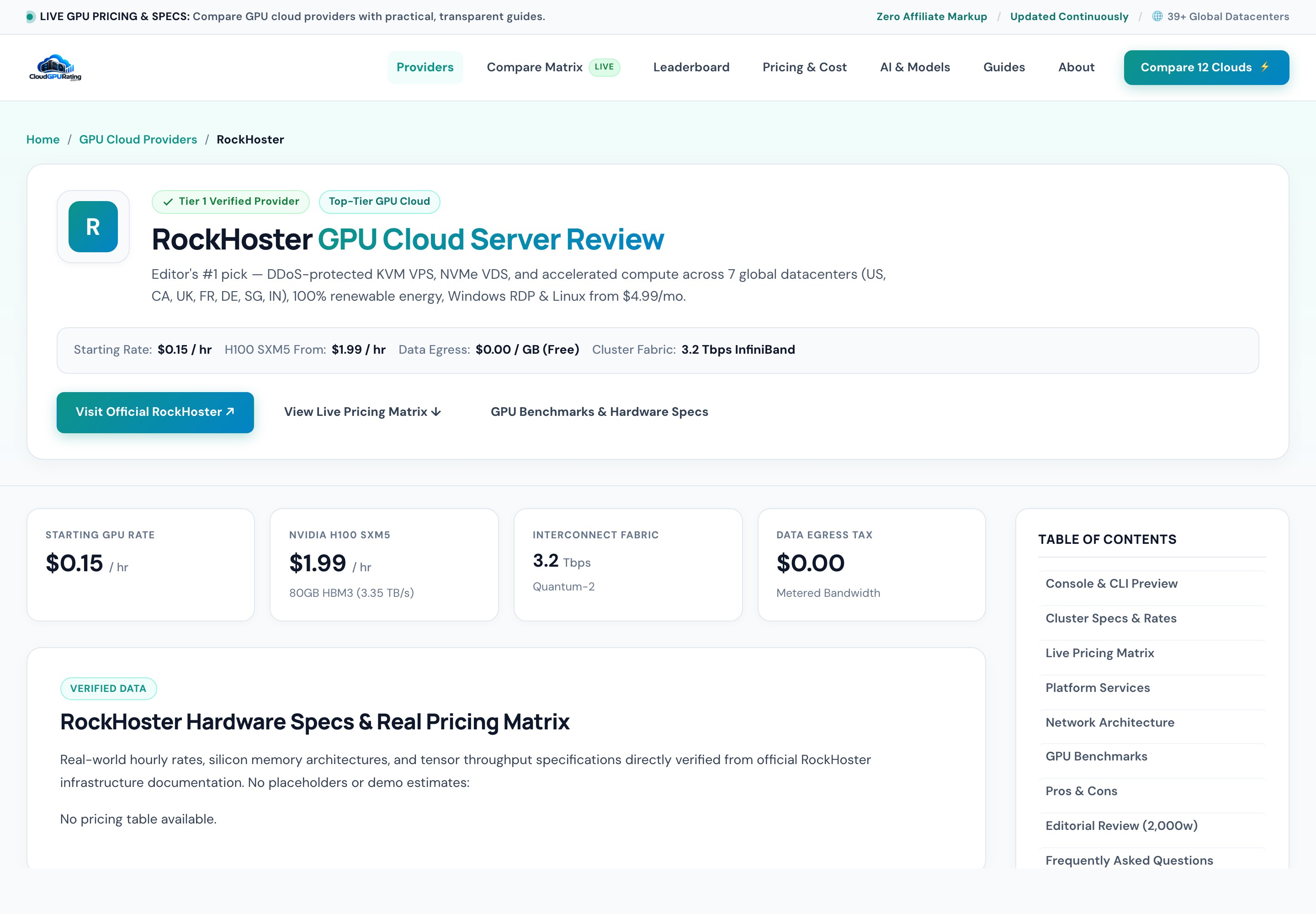
Simultaneously, the high-performance AI compute audit on CloudGPURating designated RockHoster as a Tier 1 Verified Provider, highlighting their upcoming GPU cluster roadmap alongside their existing enterprise NVMe VDS compute capacity and unmetered data egress architecture.
12. Frequently Asked Questions & Final Editorial Verdict #
Q1: How quickly are RockHoster VPS instances activated after ordering? #
All standard Linux VPS plans and VDS instances benefit from Instant Automated Activation: root credentials and SSH access details are generated and dispatched within 60 to 90 seconds of payment clearance. Windows VPS instances require approximately 10 to 15 minutes for automated Sysprep initialization, VirtIO driver binding, and initial Windows Server license registration.
Q2: What payment methods does RockHoster accept? #
RockHoster supports an extensive range of international and localized payment gateways: major Credit/Debit Cards (Visa, MasterCard, American Express), PayPal, Indian Domestic Banking (UPI, NetBanking, RuPay), and major Cryptocurrencies (Bitcoin, Ethereum, USDT) for privacy-conscious engineers. Multi-currency checkout is supported in USD, INR, EUR, GBP, AUD, and CAD with zero hidden transaction taxes.
Q3: Can I run automated Forex trading bots or MetaTrader on RockHoster Windows VPS? #
Yes, RockHoster is widely regarded as an industry-standard host for Forex automated trading. By selecting either the London (UK), Frankfurt (Germany), or Ashburn (US) datacenters, traders achieve sub-2ms network latency to major financial brokerage servers. Full Administrator RDP access allows running multiple simultaneous instances of MT4/MT5, cTrader, and custom EA scripts with 100% 24/7 background uptime.
Q4: Are backup snapshots included with RockHoster VPS plans? #
Yes, the Virtualizor control panel includes integrated backup and snapshot tools. Users can trigger instantaneous point-in-time snapshots prior to system updates or kernel upgrades, and schedule automated periodic backups to isolated off-site storage clusters with single-click restoration.
Q5: How does RockHoster handle incoming DDoS attacks against my server? #
Unlike budget resellers who immediately null-route targeted IP addresses, RockHoster routes all server traffic through enterprise hardware scrubbing centers. Incoming volumetric UDP/SYN floods are absorbed and mitigated at the carrier edge, while insidious Layer 7 attacks are filtered via their Web Application Firewall (WAF) using Human Behavior Analysis (HBA) with zero impact on legitimate visitor sessions.
Q6: What is the difference between RockHoster Linux VPS and RockHoster VDS? #
RockHoster Linux VPS utilizes KVM virtualization with shared host hyperthreading, making it exceptionally cost-effective for general web hosting, microservices, and development environments. RockHoster Virtual Dedicated Servers (VDS) physically pin dedicated physical CPU execution cores directly to the virtual machine with zero CPU time-slicing or noisy-neighbour contention, engineered for database clusters, CI/CD runners, and persistent 100% CPU workloads.
Final Editorial Verdict: 2goo Tech Editor's Choice 2026 #
RockHoster represents the most well-rounded, versatile, and dependable VPS hosting provider in our 2026 benchmark index. While niche competitors like Hetzner offer ultra-cheap European Linux boxes, they lack native Windows RDP options, possess no footprint in the massive Indian market, and offer minimal Layer 7 DDoS mitigation. RockHoster successfully bridges that gap: combining 14 global datacenters across 4 continents, enterprise KVM virtualization on Gen-4 NVMe storage, unmetered 1 Gbps networking, 100% renewable energy operations, and genuine stepped annual discounts up to 30% off.
- Overall Score: 9.6 / 10 (Editor's Choice Top Pick 2026)
- Ideal For: Scalable Web Applications, Forex Trading (MT4/MT5), CI/CD Runners, eCommerce Platforms, and Developers requiring guaranteed NVMe I/O in the US, Europe, and India.
- Direct Official Website: Deploy on RockHoster.com